Critical Leg Ischemia in Peripheral Arterial Disease
Key points
- The initial management of patients with critical leg ischemia involves pain relief including narcotics.
- Definitive evaluation and management requires arteriography and revascularization, or primary amputation.
- Current 5-year patency rates for below-knee popliteal (distal anastomosis to a modest-sized artery just below the knee) and tibial (distal anastomosis to smaller arteries at the calf level or below) bypass of 60% to 70% and 50% to 60%, respectively, have been reported by multiple centers.
- Despite these impressive patency data, 23% of bypasses will need some sort of operative revision (usually within the first year) to repair a stenotic area that develops in the vein graft.
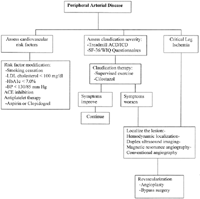
The initial management of patients with critical leg ischemia involves pain relief including narcotics. Patients with more severe disease including ischemic ulceration or gangrene also need wound care to control infection and prevention of further trauma to the extremity. Specific medical treatments for critical leg ischemia have been limited. Numerous trials have been performed in Europe using prostaglandin drugs. These trials have met with marginal success using a variety of agents. Antiplatelet therapy is critical to maintain graft patency, whereas the use of anticoagulation to maintain graft patency is empiric and done only in selected cases.
Definitive evaluation and management requires arteriography and revascularization, or primary amputation. Revascularization operations for critical limb ischemia use the patient's own veins (greater saphenous, lesser saphenous, and arm veins) as the optimal bypass conduit.
Current 5-year patency rates for below-knee popliteal (distal anastomosis to a modest-sized artery just below the knee) and tibial (distal anastomosis to smaller arteries at the calf level or below) bypass of 60% to 70% and 50% to 60%, respectively, have been reported by multiple centers. Limb salvage (prevention of amputation) rates of 80% or better for the same time interval are also the rule, which is due to success in second bypass surgeries when the first operation eventually fails. Operative mortality is 5% in most series but may reach 10% in patients over 80 years of age. Hospital stays of 10 or more days are common due to slow healing and frequent complications and comorbidities. About one-quarter to one-third of patients need to go to some sort of rehabilitation facility on discharge, although the majority will stay for only a few weeks. The decision to use surgery or angioplasty as the initial treatment option follows the TASC guidelines described earlier.
Despite these impressive patency data, 23% of bypasses will need some sort of operative revision (usually within the first year) to repair a stenotic area that develops in the vein graft. Twenty percent of patients will require at least one readmission for wound care issues, usually associated with an operative incision. The majority of patients develop significant lymphedema in the operated leg. Constant graft ultrasound surveillance to locate the asymptomatic stenoses before graft occlusion and limb threat (every 3 months for the first year and every 6 months for life) and potential revision needs lead to a substantial amount of patient anxiety.
{embed="vein/stat-menu1"}
In patients who progress to amputation, below-knee amputations are performed in patients with ambulatory potential. However, despite many different techniques, there is no guaranteed method to assure healing of below-knee amputations. Issues that complicate healing include poor circulation, chronic edema, and skin changes consistent with chronic venous disease. This difficulty is reflected in a reamputation rate to attempt below-knee salvage from 4% to 30%. Importantly, half of all below-knee amputees who fail primary healing ultimately require above-knee amputation. Primary above-knee amputation is considered the best option for patients without any ambulatory potential (dementia, stroke, obesity, etc).
Written and revised by
Andrey Nailor, M.D.
Our doctors write and review articles for accuracy and keep them up to date.
health.am provides general information, not medical advice. Always consult a qualified health professional about your own health.
Explore health topics
More in this topic
Heart & Blood Vessels → News
'Paradigm shift' in how physicians treat peripheral artery disease
A balloon angioplasty device that sucks up dangerous plaque debris could trigger a "paradigm shift" in how physicians treat peripheral artery disease, researchers write in the current issue of Endovascular Today. "We…
6 October 2010
 News
Study explains how exercise helps patients with peripheral artery disease
Peripheral artery disease (PAD) affects 5 million individuals in the U.S. and is the leading cause of limb amputations. Doctors have long considered exercise to be the single best therapy for PAD, and now a new study…
3 December 2009
 News
Vascular Surgeons Perform Most Peripheral Arterial Interventions
Vascular surgeons have the highest market share and the lowest overall mortality and morbidity rates for peripheral arterial interventions (PAI), when compared to interventional cardiologists and interventional…