
Is morning colonoscopy better?
Key points
- Studies have found that colonoscopies done in the afternoon are less likely to catch abnormal growths than those done in the morning.
- The findings, reported in the American Journal of Gastroenterology, support the idea that doctor fatigue helps explain why afternoon colonoscopies tend to catch fewer polyps.
- Polyps are growths in the colon that are usually harmless but can sometimes become cancerous.
- But that does not necessarily mean you need to worry if your colonoscopy is scheduled for the afternoon.
Studies have found that colonoscopies done in the afternoon are less likely to catch abnormal growths than those done in the morning. Now new research shows that the gap disappears when doctors work a half-day rather than a full one.
The findings, reported in the American Journal of Gastroenterology, support the idea that doctor fatigue helps explain why afternoon colonoscopies tend to catch fewer polyps.
Polyps are growths in the colon that are usually harmless but can sometimes become cancerous.
But that does not necessarily mean you need to worry if your colonoscopy is scheduled for the afternoon. Other factors - like carefully following the instructions for preparing for the colonoscopy - are more important, experts say.
For the new study, researchers at the Mayo Clinic Arizona in Scottsdale reviewed records for nearly 4,700 colonoscopies performed at their center in 2009.
Two-thirds were done by a doctor working a half-day, while doctors on a full-day schedule handled the rest.
When doctors worked a full day, the study found, polyps were detected in 26 percent of procedures done in the morning, but only 21 percent of those done in the afternoon.
That difference did not exist among doctors on half-day schedules. Polyps were found in about 27 percent of procedures done in the morning or afternoon.
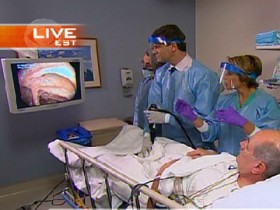
During a colonoscopy, the doctor threads a thin camera-equipped scope into the rectum and along the colon, looking for polyps and usually removing any that are found. Each exam takes about 30 minutes.
Researchers have speculated that when doctors repeatedly perform the exam all day, fatigue sets in - and that could explain the lower polyp detection rates that some studies have found later in the day.
The current findings support that notion, according to lead author Dr. Suryakanth R. Gurudu and his colleagues.
But, they write, "the exact mechanism leading to our study finding needs further evaluation."
Dr. C. Prakash Gyawali, a gastroenterologist and researcher not involved in the study, agreed that fatigue could be a factor.
"This is indirect evidence that the repetitiveness of the procedure leads to less attentiveness for detecting polyps later in the endoscopist's day," Gyawali, of Washington University School of Medicine in St. Louis, told Reuters Health in an email.
In their own recent study, Gyawali and his colleagues looked at the results of nearly 1,100 colonoscopies. They found that for each hour that passed over the course of a day, there was a 4 percent decline in the number of polyps doctors found.
There are other possible reasons for lower afternoon detection rates, however.
Written and revised by
Gerald Hurowitz, M.D.
Our doctors write and review articles for accuracy and keep them up to date.
health.am provides general information, not medical advice. Always consult a qualified health professional about your own health.
Explore health topics
More in this topic
Digestive Health → Guide
Thiopurine Immunosuppressives
Azathioprine is a pro-drug that is converted into 6-mercaptopurine (6-MP) and is subsequently metabolized by one of three different enzymes to form either active or inactive metabolites . There is substantial…
30 August 2015
GuideGlucocorticoids
Glucocorticoids are highly effective for the short- term control of Crohn's disease-related symptoms, but they are less effective for maintenance of remission, and have significant adverse effects that preclude safe…
29 August 2015
GuideAnti-Integrin Therapies
Integrins are glycoproteins expressed on the surface of circulating leukocytes and mediate their adhesion to the vascular endothelium and their subsequent migration into adjacent tissue. Anti- integrin therapies have…
28 August 2015