
Anorectal fistulas
Key points
- Anorectal fistulas are generally uncommon, with some studies reporting an incidence of 8.6 per 100,000 (16).
- There is a slight male predilection, and the average age at diagnosis is 38 years.
- Anorectal fistulas can develop in other medical disorders such as anorectal malignancy, lymphogranuloma venereum, radiation proctitis, actinomycosis, tuberculosis, and leukemia.
- The classification of fistulas is divided into 4 common types (Table II); however, they can have a complex anatomy, with 1 or more extensions and accessory tracts possible.
Anorectal fistulas are generally uncommon, with some studies reporting an incidence of 8.6 per 100,000 (16). The leading causes are nonspecific in 90% of patients. Fistulas may be associated with Crohn's disease (Figure 2), anal fissures, postoperative and perirectal/anal trauma, and infections such as a sequelae of anorectal abscesses of nonspecific anal origin (17).
There is a slight male predilection, and the average age at diagnosis is 38 years.
Anorectal fistulas can develop in other medical disorders such as anorectal malignancy, lymphogranuloma venereum, radiation proctitis, actinomycosis, tuberculosis, and leukemia.
The classification of fistulas is divided into 4 common types (Table II); however, they can have a complex anatomy, with 1 or more extensions and accessory tracts possible.
Patients with symptomatic anorectal fistulas usually require surgical management. Anal fistulas complicating Crohn's disease should be initially managed with medical therapy, which may include total parenteral nutrition, metronidazole, or a recently available option, IV infliximab, a tumor necrosis factor-α inhibitor. If in this patient population there is no healing with medical therapy, then surgical treatment should be considered.
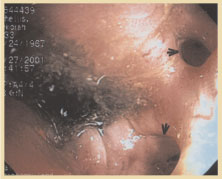
Figure 2. Endoscopic appearance of 2 rectovaginal fistulas in a patient with Crohn's disease. The goal of surgical management of anorectal fistulas is to eradicate the fistula while preserving fecal continence. Surgery usually entails an examination under anesthesia whereby the fistula is gently probed to define the anatomy. Intersphincteric fistulas are managed by a primary fistulotomy; the base of the wound is then curetted and left open to heal by secondary intention facilitated by fiber therapy and sitz baths.
Transsphincteric fistulas are usually divided into low and high fistulas. Low fistulas are managed by a primary fistulotomy with maintenance of good preoperative sphincter function. High transsphincteric and anterior fistulas are managed with a conservative approach whereby a cutting section is often performed.
This procedure involves placing a reactive suture or elastic through the fistulous tract and tightening it sequentially until it cuts through the tract. A relatively new therapy involves the injection of fibrin glue, which may eradicate fistulas in as many as 60% of patients with complicated tracts (18).
Deepak V. Gopal, MD, FRCP (C)
Written and revised by
Andrey Nailor, M.D.
Our doctors write and review articles for accuracy and keep them up to date.
health.am provides general information, not medical advice. Always consult a qualified health professional about your own health.
Explore health topics
More in this topic
Digestive Health → News
New breath test shows possible biomarker for early-stage liver disease diagnosis
A natural compound called limonene, which is found in oranges and lemons, could be indicative in early-stage diagnosis of liver disease, according to research published in the journal EBioMedicine by researchers in the…
11 August 2015
NewsThe role of intra-abdominal fat in IBD uncovered
Intra-abdominal fat cells may contribute to the development and progression of inflammatory bowel disease (IBD), according to a study1 published in Cellular and Molecular Gastroenterology and Hepatology, the basic…
6 August 2015
NewsSurgical teams reduce urinary tract infection rate by focusing on catheter use in the OR
Surgical teams at Northwestern Memorial Hospital, Chicago, are decreasing the rate of urinary tract infection (UTI) in their institution by paying scrupulous attention to the use of catheters before and immediately…