Gerald Hurowitz, M.D.·Published 3 May 2007·15 min read
Key points
Insulin is indicated for type 1 diabetes as well as for type 2 diabetic patients with insulinopenia whose hyperglycemia does not respond to diet therapy either alone or combined with other hypoglycemic drugs.
- Commercial insulin preparations differ with respect to the time of onset and duration of their biologic action.
- Four principal types of insulins are available: (1) rapid-acting insulin analogs with more rapid onset and a shorter duration of action than regular insulin after subcutaneous injection; (2) short-acting regular insulin; (3) intermediate-acting; and (4) long-acting, with slow onset of action.
Insulin syringes and needles - Plastic disposable syringes are available in 1-mL, 0.5-mL, and 0.3-mL sizes.
Insulin is indicated for type 1 diabetes as well as for type 2 diabetic patients with insulinopenia whose hyperglycemia does not respond to diet therapy either alone or combined with other hypoglycemic drugs.
With the development of highly purified human insulin preparations, immunogenicity has been markedly reduced, thereby decreasing the incidence of therapeutic complications such as insulin allergy, immune insulin resistance, and localized lipoatrophy at the injection site. However, the problem of achieving optimal insulin delivery remains unsolved with the present state of technology.
It has not been possible to reproduce the physiologic patterns of intraportal insulin secretion with subcutaneous injections of short-acting or longer-acting insulin preparations. Even so, with the help of appropriate modifications of diet and exercise and careful monitoring of capillary blood glucose levels at home, it has often been possible to achieve acceptable control of blood glucose by using various mixtures of short- and longer-acting insulins injected at least twice daily or portable insulin infusion pumps.
1. Characteristics of available insulin preparations
- Commercial insulin preparations differ with respect to the time of onset and duration of their biologic action.
a. Species of insulin - Human insulin is produced by recombinant DNA techniques (biosynthetic human insulin) as Humulin (Eli Lilly) and as Novolin (Novo Nordisk). It is dispensed as either regular (R) or NPH (N) formulations. Five analogs of human insulin - three rapidly acting (insulin lispro, insulin aspart, insulin glulisine) and two long-acting (insulin glargine and insulin detemir) - have been approved by the FDA for clinical use. Animal insulins are no longer available in the United States.
b. Purity of insulin - "Purified" insulin is defined by FDA regulations as the degree of purity wherein proinsulin contamination is less than 10 ppm. All insulins presently available contain less than 10 ppm of proinsulin and are labeled as "purified." These purified insulins seem to preserve their potency quite well, so that refrigeration is recommended but not crucial. During travel, reserve supplies of insulin can thus be readily transported for weeks without losing potency if protected from extremes of heat or cold.
c. Concentration of insulin - At present, insulins in the United States are available in a concentration of 100 units/mL (U100), and all are dispensed in 10-mL vials. With the popularity of "low-dose" (0.5- or 0.3-mL) disposable insulin syringes, U100 can be measured with acceptable accuracy in doses as low as 1-2 units. For use in rare cases of severe insulin resistance in which large quantities of insulin are required, U500 regular human insulin (Humulin R) is available from Eli Lilly.
Written and revised by
Gerald Hurowitz, M.D.
Our doctors write and review articles for accuracy and keep them up to date.
health.am provides general information, not medical advice. Always consult a qualified health professional about your own health.
- Four principal types of insulins are available: (1) rapid-acting insulin analogs with more rapid onset and a shorter duration of action than regular insulin after subcutaneous injection; (2) short-acting regular insulin; (3) intermediate-acting; and (4) long-acting, with slow onset of action. Rapid-acting insulin analogs and regular insulin are dispensed as clear solutions at neutral pH and contain small amounts of zinc to improve their stability and shelf life. The long-acting insulin analogs are also dispensed as clear solutions; insulin glargine is at acidic pH and insulin detemir is at neutral pH. NPH insulin is dispensed as a turbid suspension at neutral pH with protamine in phosphate buffer. The Lente series of insulin (ultralente and lente) are no longer available in the United States. The rapid-acting insulin analogs, intermediate-acting, and long-acting insulins are designed for subcutaneous administration, while regular insulin can also be given intravenously. Insulin aspart has been approved for intravenous use, but there is no advantage in using this insulin over regular for this purpose.
a. Rapid-acting insulin analogs - Insulin lispro (Humalog) is an insulin analog produced by recombinant technology, wherein two amino acids near the carboxyl terminal of the B chain have been reversed in position: Proline at position B28 has been moved to B29 and lysine has been moved from B29 to B28. Insulin aspart (Novolog) is a single substitution of proline by aspartic acid at position B28. Insulin glulisine (Apidra) differs from human insulin in that the amino acid asparagine at position B3 is replaced by lysine and the lysine in position B29 by glutamic acid. These changes result in these three analogs having less tendency to form hexamers, in contrast to human insulin. When injected subcutaneously, the analogs quickly dissociate into monomers and are absorbed very rapidly, reaching peak serum values in as soon as 1 hour - in contrast to regular human insulin, whose hexamers require considerably more time to dissociate and become absorbed. The amino acid changes in these analogs do not interfere with their binding to the insulin receptor, with the circulating half-life, or with their immunogenicity, which are all identical with those of human regular insulin.
Clinical trials have demonstrated that the optimal times of preprandial subcutaneous injection of comparable doses of the rapid-acting insulin analogs and of regular human insulin are 20 minutes and 60 minutes, respectively, before the meal. While this more rapid onset of action has been welcomed as a great convenience by diabetic patients who object to waiting as long as 60 minutes after injecting regular human insulin before they can begin their meal, patients must be taught to ingest adequate absorbable carbohydrate early in the meal to avoid hypoglycemia during the meal. Another desirable feature of insulin lispro is that its duration of action remains at about 4 hours irrespective of dosage. This contrasts with regular insulin, whose duration of action is prolonged when larger doses are used.
The rapid-acting analogs are also commonly used in pumps. In a double-blind crossover study comparing insulin lispro with regular insulin in insulin pumps, persons using insulin lispro had lower HbA1c values and improved postprandial glucose control with the same frequency of hypoglycemia. The concern remains that in the event of pump failure, users of the rapid-acting insulin analogs will have more rapid onset of hyperglycemia and ketosis.
b. Short-acting regular insulin - Regular insulin is a short-acting soluble crystalline zinc insulin whose effect appears within 30 minutes after subcutaneous injection and lasts 5-7 hours when usual quantities are administered. Intravenous infusions of regular insulin are particularly useful in the treatment of diabetic ketoacidosis and during the perioperative management of insulin-requiring diabetics. When intravenous insulin is needed for hyperglycemic emergencies, the rapid-acting insulin analogs have no advantage over regular human insulin, which is instantly converted to the monomeric form when given intravenously. Regular insulin is indicated when the subcutaneous insulin requirement is changing rapidly, such as after surgery or during acute infections - although the rapid-acting insulin analogs may be preferable in these situations.
For markedly insulin-resistant persons who would otherwise require large volumes of insulin solution, a U500 preparation of human regular insulin is available. Since a U500 syringe is not available, a U100 insulin syringe or tuberculin syringe is used to measure doses. The physician should carefully note dosages in both units and volume to avoid overdosage.
c. Intermediate-acting neutral protamine Hagedorn (NPH) insulin - NPH (neutral protamine Hagedorn or isophane) insulin is an intermediate-acting insulin whose onset of action is delayed by combining 2 parts soluble crystalline zinc insulin with 1 part protamine zinc insulin. This produces equivalent amounts of insulin and protamine, so that neither is present in an uncomplexed form ("isophane").
Its onset of action is delayed to 2-4 hours, and its peak response is generally reached in about 8-10 hours. Because its duration of action is often less than 24 hours (with a range of 10-20 hours), most patients require at least two injections daily to maintain a sustained insulin effect. Occasional vials of NPH insulin have tended to show unusual clumping of their contents or "frosting" of the container, with considerable loss of bioactivity. This instability is rare and occurs less frequently if NPH human insulin is refrigerated when not in use and if bottles are discarded after 1 month of use.
{pagebreak} d. Long-acting insulins - (1) Insulin glargine - This agent is an insulin analog in which the asparagine at position 21 of the A chain of the human insulin molecule is replaced by glycine and two arginines are added to the carboxyl terminal of the B chain. The arginines raise the isoelectric point of the molecule closer to neutral, making it more soluble in an acidic environment. In contrast, human insulin has an isoelectric point of pH 5.4. Insulin glargine is a clear insulin which, when injected into the neutral pH environment of the subcutaneous tissue, forms microprecipitates that slowly release the insulin into the circulation. It lasts for about 24 hours without any pronounced peaks and is given once a day to provide basal coverage. This insulin cannot be mixed with the other human insulins because of its acidic pH. When this insulin was given as a single injection at bedtime to type 1 patients, fasting hyperglycemia was better controlled when compared with bedtime NPH insulin. The clinical trials also suggest that there may be less nocturnal hypoglycemia with this insulin when compared with NPH insulin.
In one clinical trial involving type 2 patients, insulin glargine was associated with a slightly higher progression of retinopathy when compared with NPH insulin. The frequency was 7.5% with the analog and 2.7% with the NPH. This finding, however, was not seen in other clinical trials with this analog. Insulin glargine does have a sixfold greater affinity for IGF-1 receptor compared with the human insulin. There has also been a report that insulin glargine had increased mitogenicity compared with human insulin in a human osteosarcoma cell line. The significance of these observations is not yet clear. Because of lack of safety data, use of insulin glargine during pregnancy is not recommended.
(2) Insulin detemir - This agent is an insulin analog in which the tyrosine at position 30 of the β chain has been removed and a 14-C fatty acid chain (tetradecanoic acid) is attached to the lysine at position 29 by acylation. The fatty acid chain makes the molecule more lipophilic than native insulin and the addition of zinc stabilizes the molecule and leads to formation of hexamers. After injection, self-association at the injection site and albumin binding in the circulation via the fatty acid side chain, leads to slower distribution to peripheral target tissues and prolonged duration of action. The affinity of insulin determir is fourfold to fivefold lower than that of human soluble insulin and therefore the U100 formulation of insulin detemir has an insulin concentration of 2400 nmol/mL compared with 600 nmol/mL for NPH. The duration of action for insulin detemir is about 17 hours at therapeutically relevant doses. It is recommended that the insulin be injected once or twice a day to achieve a stable basal coverage. This insulin has been reported to have lower within-subject pharmacodynamic variability compared with NPH insulin and insulin glargine. In vitro studies do not suggest any clinically relevant albumin binding interactions between insulin detemir and fatty acids or protein-bound drugs. Since there is a vast excess (~400,000) of albumin binding sites available in plasma per insulin detemir molecule, it is unlikely that hypoalbuminemic disease states will affect the ratio of bound to free insulin detemir.
e. Mixtures of insulin - Since intermediate insulins require several hours to reach adequate therapeutic levels, their use in patients with type 1 diabetes requires supplements of regular or rapid-acting insulin analogs preprandially. For convenience, regular or rapid-acting insulin analogs and NPH insulin may be mixed together in the same syringe and injected subcutaneously in split dosage before breakfast and supper. It is recommended that the regular insulin or rapid-acting insulin analog be withdrawn first, then the NPH insulin and that the injection be given immediately after loading the syringe. Stable premixed insulins (70% NPH and 30% regular or 50% of each) are available as a convenience to patients who have difficulty mixing insulin because of visual problems or impairment of manual dexterity. Premixed preparations of insulin lispro and NPH insulins are unstable because of exchange of insulin lispro with the human insulin in the protamine complex. Consequently, the soluble component becomes over time a mixture of regular and insulin lispro at varying ratios. In an attempt to remedy this, an intermediate insulin composed of isophane complexes of protamine with insulin lispro was developed called NPL (neutral protamine lispro). This insulin has the same duration of action as NPH insulin. Premixed combinations of NPL and insulin lispro (eg, 75:25, 50:50, and 25:75 of NPL:insulin lispro) have been tested. Both 75% NPL/25% insulin lispro mixture (Humalog Mix 75/25) and 50% NPL/50% insulin lispro mixture (Humalog Mix 50/50) are available for clinical use. Similarly, a 70% insulin aspart protamine/30% insulin aspart (NovoLogMix 70/30) is available. The main advantages of these mixtures is that they can be given within 15 minutes of starting a meal and they are superior in controlling the postprandial glucose rise after a carbohydrate rich meal. These benefits have not translated into improvements in HbA1c levels when compared with the usual 70% NPH/30% regular mixture. The longer-acting insulin analogs cannot be mixed with either regular insulin or the rapid-acting insulin analogs.
{pagebreak}
3. Methods of insulin administration
-
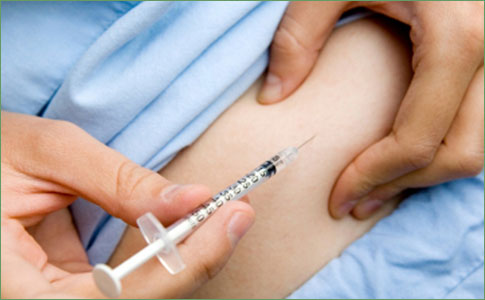
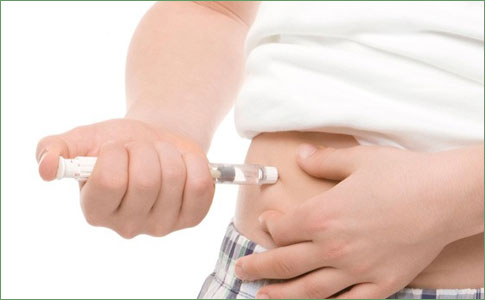
a. Insulin syringes and needles - Plastic disposable syringes are available in 1-mL, 0.5-mL, and 0.3-mL sizes. The "low-dose" 0.3-mL syringes have become increasingly popular, because many diabetics do not take more than 30 units of insulin in a single injection except in rare instances of extreme insulin resistance. Two lengths of needles are available: short (8 mm) and long (12.7 mm). Long needles are preferable in obese patients to reduce variability of insulin absorption. Ultrafine needles as small as 31 gauge reduce the pain of injections. "Disposable" syringes may be reused until blunting of the needle occurs (usually after three to five injections). Sterility adequate to avoid infection with reuse appears to be maintained by recapping syringes between uses. Cleansing the needle with alcohol may not be desirable since it can dissolve the silicone coating and can increase the pain of skin puncturing.
Any part of the body covered by loose skin can be used, such as the abdomen, thighs, upper arms, flanks, and upper buttocks. Preparation with alcohol is no longer required prior to injection as long as the skin is clean. Rotation of sites continues to be recommended to avoid delayed absorption when fibrosis or lipohypertrophy occurs from repeated use of a single site. However, considerable variability of absorption rates from different sites, particularly with exercise, may contribute to the instability of glycemic control in certain type 1 patients if injection sites are rotated too frequently in different areas of the body. Consequently, it is best to limit injection sites to a single region of the body and rotate sites within that region. The abdomen is recommended for subcutaneous injections, since regular insulin has been shown to absorb more rapidly from there than from other subcutaneous sites. The effect of anatomic regions appears to be much less pronounced with the analog insulins.
b. Insulin pen injector devices - Insulin pens eliminate the need for carrying insulin vials and syringes. Cartridges of insulin lispro, insulin aspart, insulin glargine, regular insulin, NPH insulin, and 70% NPH/30% regular insulin are available for reusable pens (Novo Nordisk, Becton Dickinson, and Sanofi Aventis pens). Disposable prefilled pens are also available for insulin lispro, NPH, 70% NPH/30% regular, 75% NPL/25% insulin lispro, 50% NPL/50% insulin lispro, and 70% insulin aspart protamine/30% insulin aspart. Thirty-one gauge needles (5, 6, and 8 mm long) for these pens make injections almost painless.
c. Insulin pumps - In the United States, Medtronic Mini-Med, Animas, and Deltec Cozmo insulin infusion pumps are available for subcutaneous delivery of insulin. These pumps are small (about the size of a pager) and very easy to program. They offer many features, including the ability to set a number of different basal rates throughout the 24 hours and to adjust the time over which bolus doses are given. They also are able to detect pressure build-up if the catheter is kinked. Improvements have also been made in the infusion sets. The catheter connecting the insulin reservoir to the subcutaneous cannula can be disconnected, allowing the patient to remove the pump temporarily (eg, for bathing). The great advantage of continuous subcutaneous insulin infusion (CSII) is that it allows for establishment of a basal profile tailored to the patient. The patient therefore is able to eat with less regard to timing because the basal insulin infusion should maintain constant blood glucose between meals. Also the ability to adjust the basal insulin infusion makes it easier for the patient to manage glycemic excursions that occur with exercise.
CSII therapy is appropriate for patients who are motivated, mechanically inclined, educated about diabetes (diet, insulin action, treatment of hypoglycemia and hyperglycemia), and willing to monitor their blood glucose four to six times a day. Known complications of CSII include ketoacidosis, which can occur when insulin delivery is interrupted, and skin infections. Another disadvantage is its cost and the time demanded of physicians and staff in initiating therapy.
d. Inhaled insulin - A novel method for delivering a preprandial powdered form of insulin by inhalation (Exubera) has been approved by the FDA. In the clinical trials that led to the approval of this preparation, approximately 2500 adult patients with type 1 and type 2 diabetes were studied. The inhaled insulin was as effective as subcutaneous regular insulin in controlling postprandial glucose excursions, but the studies did not compare inhaled insulin with the short-acting insulin analogs.
Pharmacokinetic studies of the inhaled preparation show that it is rapidly absorbed and its onset of action is 32 minutes, compared with 48 and 41 minutes for regular insulin and insulin lispro, respectively. However, the metabolic effect is slower, and the duration of action is longer than insulin lispro and comparable to regular insulin. The bioavailability of inhaled insulin is about 10%, and so patients would need to inhale about 300-400 units of insulin a day. Inhaled insulin is administered 10 minutes prior to meals using a combination of 1- and 3-mg unit doses; 1 mg of inhaled insulin is equivalent to 3 units subcutaneous insulin injection.
Because consecutive inhalation of three 1-mg blisters is associated with a 30-40% greater insulin exposure than one 3-mg dose blister, the two regimens are not interchangeable. A small decrease in pulmonary function (forced expiratory volume in 1 second [FEV1] and single-breath diffusing capacity for carbon monoxide [DLCO]) was seen in the first few months of use, but in the phase 3 studies lasting 2 years, patients did not experience clinically significant effects on pulmonary function. The clinical trials excluded patients with pulmonary disorders. Inhaled insulin does result in higher insulin antibody titers than subcutaneous insulin, but the studies so far have not shown any clinical impact on dosage or control. Other side effects associated with Exubera therapy include cough, shortness of breath, sore throat, and dry mouth. Smokers have higher insulin levels than nonsmokers, so this insulin preparation is contraindicated in patients who smoke or who have discontinued smoking for less than 6 months. The FDA has recommended pulmonary function tests at baseline, after 6 months of treatment and every year thereafter, even if there are no pulmonary symptoms.

 News
 News