Gerald Hurowitz, M.D.·Published 4 June 2010·7 min read
Key points
Everyone needs some fat in their diet to make sure their bodies function properly.
But too much fat can clog up blood vessels and increase your chances of developing heart disease and stroke.
Cholesterol is a kind of lipid substance that your body makes.
It is also used to make many of the steroid hormones such as estrogen and testosterone that your body needs.
Everyone needs some fat in their diet to make sure their bodies function properly. Fats are used to rebuild the membranes that protect the cells in your body and to help the cells in your body send signals. Fats are also stored and used as energy reserves.
But too much fat can clog up blood vessels and increase your chances of developing heart disease and stroke. Many Americans eat too much fat. For healthy living, you are better off trying to limit the amount of fat, especially saturated fat and trans fatty acids.
Cholesterol is a kind of lipid substance that your body makes. It is used to make and repair the cell membranes in your body.
Skinny Meat There are several ways you can reduce the fat in meat:
Broil, roast, grill, steam, or poach instead of frying.
Cut off all visible fat before or after cooking and remove the skin from chicken and turkey.
Chill meat broth and drippings so the fat rises and solidifies. Then it can be skimmed off the top before serving or making gravy. You can also use this method to reduce the fat in canned or homemade broths and soups.
Buy lean cuts of meat. Ask your butcher to tenderize them through mechanical means rather than with chemical additives.
Try quick-cooking methods such as stir-frying meat that you have marinated using tiny amounts of olive or canola oil or dressing with lots of seasoning to enhance juiciness and flavor.
{embed="ref/stat-menu-diabetes6"}
It is also used to make many of the steroid hormones such as estrogen and testosterone that your body needs. But too much cholesterol in the blood can clog your arteries and cause heart disease and stroke. In addition to the cholesterol your body makes on its own, the cholesterol and saturated fats that you eat can raise blood cholesterol levels.
Harvey was at risk for a heart attack. He already knew he had type 2 diabetes. He was about 50 pounds overweight and was doing his best to watch his carbohydrate intake. But, when he visited his provider for a checkup last year, he found that his cholesterol level had skyrocketed.
He decided to cut down on the cholesterol in his diet by avoiding eggs and not eating red meats. But, his cholesterol levels were about the same. As his dietitian explained, eating less cho- lesterol is one step to reducing blood cholesterol but is not benefi- cial if the saturated fats and trans fatty acids in the diet are not also reduced. Your body makes cholesterol from the saturated and
Written and revised by
Gerald Hurowitz, M.D.
Our doctors write and review articles for accuracy and keep them up to date.
health.am provides general information, not medical advice. Always consult a qualified health professional about your own health.
trans fats in your diet. She recommended switching to low-fat
dairy products and leaner cuts of meat to reduce Harvey's intake
of cholesterol and saturated fat. After several months of using
skim milk and low-fat cheeses instead of the high-fat varieties he
was used to, Harvey saw his cholesterol levels start to come down.
How do you know how much fat is in the food you eat? Sometimes it can be difficult, especially when you are eating out. For foods you buy and prepare yourself, check the food labels. The Nutrition Facts label tells you how much fat, saturated fat, and calories from fat are in one serving. If you are cooking a meal or dish with lots of ingredients, try to add up the fat and calories from each ingredient and divide by the number of servings. If you are eating out, many restaurants, particularly chain and fast food restaurants, now provide nutritional information on request. If you are uncertain about any foods, ask your dietitian for an estimate. At the end of the day, add up all the calories from fat from the labels on the foods you've eaten and any other hidden fats in foods without labels. This will give you the total of daily calories from fat. Divide this by the total calories you've eaten for the day and multiply by 100.
This will give you the percent of total calories from fat.
Figuring Out Fat Many people with diabetes have high cholesterol levels. If you need to limit your fat and cholesterol intake, try not to eat more than 300 milligrams of cholesterol a day. If your LDL cholesterol is over 100 mg/dl, you may benefit by reducing your cholesterol intake to less than 200 milligrams per day. Less than 30 percent of your total calories each day should come from fat (with less than 10 percent from saturated fats). If you find that you've eaten too much fat or cholesterol in one day, eat less for the next couple of days.
Here's an easy way to figure out how much fat to eat each day.
First, decide on the number of calories you eat in a day. Let's say you eat 1,800 calories a day. Drop the last number, so 1,800 becomes 180. Now divide by 3. The answer, which is 60, is the number of grams of fat you can eat each day and still end up eating less than 30 percent of your total calories from fat.
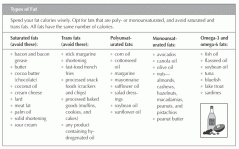
Hidden Fat. Be careful when you find cookies marked as "sugar free" or other desserts marketed specifically for people with diabetes. They may be sugar free, but more than 60 percent of their calories can come from fat. You will find saturated fat in all animal products such as butter, whole milk, half-and-half, and meat fat. The vegetable products high in saturated fats and trans fatty acids are palm oil, palm kernel oil, cocoa butter (chocolate), coconut oil, solid shortening, and partially hydrogenated oils. Often these fats are found in mixes for pancakes, biscuits, cookies, crackers, cakes, and some snack chips.
{pagebreak}
Preferred Fats. Not all fats are created equal. To keep your heart and blood vessels healthy, choose fats that are not saturated.
Unsaturated fats (monounsaturated and polyunsaturated) are found mostly in plant foods, such as nuts and olives.
{embed="ref/stat-menu-diabetes6"}
Cutting Down on Fat and Cholesterol The following simple steps can help keep dietary fat and cholesterol in check:
Choose lean cuts of meat. Look for descriptions such as loin, round, lean, choice, and select
Remove visible fat from meats and skin from poultry, preferably before cooking.
Choose fish and skinless poultry and lean meats.
Try to limit your portions of lean meat, fish, or poultry to 3 ounces per meal - about the size of a deck of cards. One half of a skinless, boneless chicken breast is about 3 ounces of meat.
Avoid fried foods.
Limit the number of eggs you eat to four per week.
Use a nonfat cooking spray on pans and cooking utensils to prevent sticking.
Select reduced-fat or fat-free dairy products, such as salad dressings, baked goods, luncheon meats, soups, and dairy products
They are usually liquid at room temperature, as opposed to saturated fats, which are usually solid at room temperature. Corn, cottonseed, sunflower, saffiower, and soybean oils are all polyunsaturated, whereas olive and canola oils are monounsaturated.
It is recommended that people with diabetes decrease saturated fat intake to less than 10 percent of calories and eliminate trans fats. Select the rest of your fats from food with mono- or polyunsaturated fats. Omega-3 and omega-6 fats are found in fish oil and flaxseed and soybean oils. Tuna, bluefish, lake trout, and sardines are all high in omega-3 fats. These lower triglycerides and help protect your heart. Three servings per week are recommended. Choose margarine that has a liquid oil, such as olive oil or soybean oil, as its first ingredient rather than a partially hydrogenated oil or trans fat. Hydrogenated margarine has 0.6 grams of saturated fat per teaspoon and butter has 2.5 grams per teaspoon.
Trans fats are produced when liquid oil is made into a solid fat through a process called hydrogenation. Trans fats act like saturated fats and can raise your cholesterol level. Beginning in 2006, trans fat will be listed in product nutrition labels, making it easier to identify them. You can also find out which foods contain trans fats by reading the ingredient list on food labels. Look for phrases like hydrogenated oil or partially hydrogenated oil and avoid foods that have these ingredients. Trans fats show up in many processed snack foods, such as crackers and chips, and in processed baked goods, such as muffins, cakes, and cookies. Fast-food items such as french fries may contain trans fats.
-- Martha M. Funnell, MS, RN, CDE Michigan Diabetes Research and Training Center University of Michigan Medical School Ann Arbor, Michigan
Robert M. Anderson, EdD
Michigan Diabetes Research and Training Center University of Michigan Medical School Ann Arbor, Michigan
Shereen Arent, JD
National Director of Legal Advocacy American Diabetes Association
American Diabetes Association Complete Guide to Diabetes

 News
 News
 News