
Does Exercise Correct Overweight/Obesity?
Key points
- Theoretically, overweight could be corrected by an increase of physical activity; in order to burn 0.1 kg of fat 700 kcal need to be expended, i.e., 90 min of bicycle exercise at an intensity of 100 Watts.
- Requirements to loose significant amounts of weight (>10 kg) and maintain it by exercise only are impressive: 2500 to 2800 kcal need to be expended per week requiring a minimum of 5 to 6 h of exercise at moderate levels (500 kcal/h) (30 - 35).
- It is quite obvious that only exceptionally motivated patients are willing to invest the time and the effort to achieve this goal.
- After having been inactive for the better part of their life it would be quite unrealistic to expect radical changes from patients after the age of 50.
In the metabolic syndrome/diabetes type 2 overweight and physical inactivity are the most conspicuous problems (Fig. 4).
Theoretically, overweight could be corrected by an increase of physical activity; in order to burn 0.1 kg of fat 700 kcal need to be expended, i.e., 90 min of bicycle exercise at an intensity of 100 Watts.
Requirements to loose significant amounts of weight (>10 kg) and maintain it by exercise only are impressive: 2500 to 2800 kcal need to be expended per week requiring a minimum of 5 to 6 h of exercise at moderate levels (500 kcal/h) (30 - 35).
It is quite obvious that only exceptionally motivated patients are willing to invest the time and the effort to achieve this goal. Moreover, as a result of excessive overweight many patients have lost the capability to undergo such demanding exercise programs.
After having been inactive for the better part of their life it would be quite unrealistic to expect radical changes from patients after the age of 50. Thus, most studies relying on exercise only to reduce weight have yielded disappointing results (35,36). Long-term reduction and maintenance of weight can only be achieved by the combination of exercise and reduction of caloric intake.
Even after a highly successful and promising start it is difficult for most patients to maintain it for longer periods of time, the daily routines of life slowly erode the initial success and lead to a relentless increase in body weight (37,38). Despite widespread public awareness this epidemic has spread to the younger generation; it can be safely assumed that more than 25% of the school children are overweight at the present time (39,40).
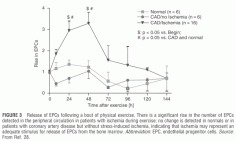
FIGURE 3 Release of EPCs following a bout of physical exercise. There is a significant rise in the number of EPCs detected in the peripheral circulation in patients with ischemia during exercise; no change is detected in normals or in patients with coronary artery disease but without stress-induced ischemia, indicating that ischemia may represent an adequate stimulus for release of EPCs from the bone marrow. Abbreviation: EPC, endothelial progenitor cells.
Gerhard Schuler and Axel Linke
Department of Internal Medicine/Cardiology, University of Leipzig, Leipzig, Germany
Written and revised by
David Cohen, M.D.
Our doctors write and review articles for accuracy and keep them up to date.
health.am provides general information, not medical advice. Always consult a qualified health professional about your own health.
Explore health topics
More in this topic
Diabetes & Hormones → News
Researchers identify role for protein linked to obesity, type 2 diabetes
Researchers at UT Southwestern Medical Center have taken another step toward better understanding the metabolic functions of obesity and its connection to type 2 diabetes. Dr. Philipp Scherer, Director of the Touchstone…
18 December 2012
 News
Study shows overeating impairs brain insulin function, can lead to diabetes and obesity
New research from Mount Sinai School of Medicine sheds light on how overeating can cause a malfunction in brain insulin signaling, and lead to obesity and diabetes. Christoph Buettner, MD, PhD, Associate Professor of…
18 October 2012
 News
Brain neurons and diet influence onset of obesity and diabetes in mice
The absence of a specific type of neuron in the brain can lead to obesity and diabetes in mice report researchers in The EMBO Journal. The outcome, however, depends on the type of diet that the animals are fed. A lack…







