Diabetes-Related Emotional Distress
Key points
- It is common for patients to experience emotional distress from living with diabetes and the impact of its complications.
- This is a brief, one-page screening tool that can be used by busy diabetes clinicians to gather information about patient concerns that may affect their self-care behaviors.
- It can be given to patients routinely, to screen for overall high emotional distress related to living with type 1 or type 2 diabetes.
- A cutoff score of 50 denotes a high level emotional distress that warrants further professional attention.
It is common for patients to experience emotional distress from living with diabetes and the impact of its complications. The terms "diabetes burnout" (32) and "diabetes overwhel-mus" (30) have been coined to capture this distress. The types of specific emotional problem faced by type 2 diabetes patients have been reported in several studies (38 - 40). Approximately one third reported "worry about the future and the possibility of diabetes complications" as a serious issue. Other areas endorsed as "serious" by approximately 15% to 20% of patients included:
- Guilt and anxiety at being off-track with treatment
- Scared about living with diabetes
- Not knowing if mood or feelings were related to diabetes
- Being constantly concerned about food and eating
- Feeling deprived around food
- Feeling depressed living with diabetes
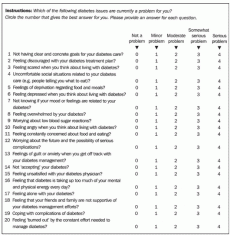
The questionnaire used in these surveys is the problem areas in diabetes (PAID) scale (see Fig. 1) (40,41). This is a brief, one-page screening tool that can be used by busy diabetes clinicians to gather information about patient concerns that may affect their self-care behaviors.
It can be given to patients routinely, to screen for overall high emotional distress related to living with type 1 or type 2 diabetes. A total score (overall emotional distress) is generated by simply adding the 0 to 4 values endorsed by the patient for each of the 20 questions in the PAID. This sum is then multiplied by 1.25 to provide a total score of 0 to 100.
A cutoff score of 50 denotes a high level emotional distress that warrants further professional attention. Individual questions scored as "serious" (i.e., scored 4 on a scale of 0 - 4) identify individual areas that a patient finds difficult. These are specific "hot spots" with which the patient is currently struggling emotionally.
For patients scoring high on the total score or individual questions, the clinician might consider investing additional time exploring feelings and practical barriers to good diabetes self-care. It is rare in medical settings for patients to be asked even briefly about their illness-related feelings - despite the great value of this exercise to clinician for patients troubled with the emotional burden of diabetes (30,31).
A key task for the clinician is to give the patient a brief opportunity (i.e., a few minutes) to talk about how he or she feels about living with diabetes. The aim is to talk with the patient about feelings openly and in a safe way (supportive, nonjudgmental). Good listening skills start with open questions, to stimulate the patient to talk about his or her feelings. For example, if a patient scores high on the PAID (above 50), the clinician may say:
Written and revised by
Gerald Hurowitz, M.D.
Our doctors write and review articles for accuracy and keep them up to date.
health.am provides general information, not medical advice. Always consult a qualified health professional about your own health.
Explore health topics
More in this topic
Diabetes & Hormones → News
Factors outside diabetes contribute to obesity-related cancer
A recent study conducted in the United Kingdom indicates that Diabetes is not the cause of the growing number of Obesity and alcohol-related Cancers . Researchers published their findings in the May issue of the British…
19 August 2005
 News
Pregnancy-related diabetes rising in the U.S.
The proportion of U.S. women who develop Diabetes during pregnancy - that is, gestational diabetes - appears to be increasing, which may be a reflection of the well-documented obesity epidemic, researchers from Denver…
26 March 2005
 News
Poor footwear ups diabetes-related amputation risk
Among people with diabetes, wearing inadequate footwear triples the risk of lower-leg amputation, according to a report from Barbados. Prompted by anecdotal reports of high rates of diabetes-related amputation rates in…