Childhood Obesity Prevention from Pregnancy and Infancy Onward
Key points
- First Lady Michelle Obama unveiled her “Let’s Move” campaign against childhood obesity on February 9, 2010.
- From the Department of Pediatrics, University of California, San Francisco, San Francisco.
- Summerbell CD, Waters E, Edmunds LD, Kelly S, Brown T, Campbell KJ.
- This innovative multifactorial approach has potential for altering the course of the childhood obesity crisis — changing our country’s approach to eating, nutrition, and physical activity by simultaneously targeting individuals, neighborhoods, and larger communities.
First Lady Michelle Obama unveiled her “Let’s Move” campaign against childhood obesity on February 9, 2010. The program’s main antiobesity strategies are empowering parents and consumers by revamping the nutritional labeling of products by the U.S. Department of Agriculture (USDA), improving the nutritional standards of the National School Lunch Program, increasing children’s opportunities for physical activity, and improving access to high-quality foods in all U.S. communities (www.letsmove.gov).
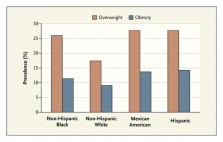
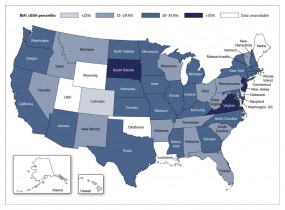
This innovative multifactorial approach has potential for altering the course of the childhood obesity crisis — changing our country’s approach to eating, nutrition, and physical activity by simultaneously targeting individuals, neighborhoods, and larger communities. Current data on obesity in school-age children are sobering. Almost one third of U.S. children over 2 years of age are already overweight or obese, according to the 2007–2008 National Health and Nutrition Examination Survey (see graph), and among low-income children 2 to 5 years of age who are enrolled in federally funded health programs, the proportions range as high as 39% (see map, and the interactive map available with the full text of this article at NEJM.org).
But systematic reviews indicate that, at best, behavioral and nutrition interventions in schools or within the home have limited success in preventing weight gain in children. At as early as 3 years of age, obese children have elevated levels of inflammatory markers that have been linked to heart disease that is manifested later in life. To be a truly comprehensive and successful program, then, the Let’s Move campaign must stimulate prevention efforts targeting the youngest Americans — those under 2 years of age and preschoolers. Indeed, prevention must start as early as possible, since school-age children already have an unacceptably high prevalence of obesity and associated medical conditions.
Factors associated with increased risk for overweight or obesity in infancy and early childhood include excessive maternal weight gain or smoking during gestation, shorter-than-recommended duration of breast-feeding, and suboptimal amounts of sleep during infancy. Such exposures during early development program a person's long-term regulation of energy balance and may have epigenetic effects. These exposures probably influence the development of hypothalamic circuits that regulate body weight, as well as endocrine pancreatic function, changes in the proportion of lean versus fat body mass, and other cycles of metabolic programming.
Interventions designed to reduce excessive weight gain and smoking during pregnancy, to increase the duration of breast-feeding, and to increase sleep duration during infancy could target U.S. children before they became overweight or obese, intervening in the cycle of metabolic programming that can be influenced by these early-life exposures. We believe that these types of interventions are crucial to include in a comprehensive obesity-prevention effort, since they affect a child's lifetime risk of obesity.
Written and revised by
David Cohen, M.D.
Our doctors write and review articles for accuracy and keep them up to date.
health.am provides general information, not medical advice. Always consult a qualified health professional about your own health.
Explore health topics
More in this topic
Children's Health → News
New Genes Associated With Childhood Obesity
Obesity has increasingly received public attention for being a major health issue in modern societies. In 2010, more than one third of children and adolescents were overweight or obese. Genes, environment, and behavior…
11 April 2013
 News
Finding genes for childhood obesity
Researchers have identified four genes newly associated with severe childhood obesity. They also found an increased burden of rare structural variations in severely obese children. The team found that structural…
8 April 2013
 News
Is guided self-help effective in treating childhood obesity?
It is known that family-based treatment that combines nutrition and exercise education, along with behavior modification, is a good approach to help children lose weight. But clinic-based weight-control programs for…
2 April 2013