Thoracic Wall - Adult Breast Morphology
Key points
- The thoracic wall is composed of the 12 thoracic vertebra, 12 ribs and costal cartilages, sternum and associated muscles.
- Between the costal cartilages, the muscle is replaced by the external intercostal membrane.
- Anatomical structures of the breast and underlying chest wall.
- Posteriorly, they extend only as far as the costal angles and continue as the internal intercostal membranes.
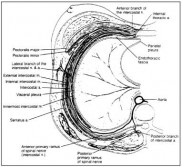
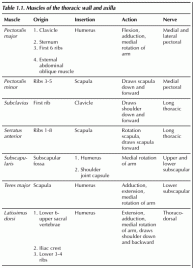
The thoracic wall is composed of the 12 thoracic vertebra, 12 ribs and costal cartilages, sternum and associated muscles. The external, internal, innermost intercostal muscles, intercostal vessels and nerves lie in the intercostal spaces. All three are thin sheets of muscles whose fibers run from one rib to the next. The external intercostal muscles begin posteriorly, lateral to the tubercle of the rib, and extend anteriorly, past the costochondral junction.
Between the costal cartilages, the muscle is replaced by the external intercostal membrane. The fibers slant downward and forward from one rib to the other. The internal intercostal muscle fibers run in the opposite direction, upward and forward from the upper border of one rib to the lower border of the next one. The muscle fibers of this layer reach the sternum anteriorly.
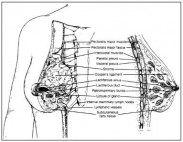
Fig. 1.1. Anatomical structures of the breast and underlying chest wall. Reprinted with permission from: Bland KI, Copeland III EM, eds. The Breast: Comprehensive Management of Benign and Malignant Diseases. 2nd ed. 1998; 9-36. ©1998 W.B. Saunders Co.
Posteriorly, they extend only as far as the costal angles and continue as the internal intercostal membranes. The innermost intercostal muscles lie internal to the internal intercostals and occupy chiefly the middle part of the length of each intercostal space. They are less well developed and are separated from the intercostal muscles by the intercostal nerves and vessels. The subcostal and transversus thoracis muscles are located on the internal surface of the thoracic wall. The subcostal muscles are variable fiber bundles posteriorly placed that span two to three intercostal spaces. The transversus thoracis is a thin layer of muscle whose fibers arise from the posterior surface of the lower part of the sternum to the neighboring costal cartilages. The thoracic wall is innervated by the ventral rami of T1 to T12 spinal nerves. T1 to T11 are the intercostal nerves, and T12 is the subcostal nerve. These nerves innervate all the muscles and give branches to the overlying skin as lateral cutaneous nerves.
The upper six terminate as the anterior cutaneous nerves, superficially. The lower six terminate as the thoracoabdominal nerves, innervating the anterior abdominal wall. The nerve lies below the vein and artery. In each intercostal space, there are two sets of intercostal arteries, posterior and anterior, that anastomose with each other.
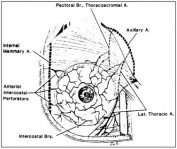
Fig. 1.2. Arterial blood supply to the breast. The main blood supply is from the internal mammary artery and lateral thoracic artery. Reprinted with permission from: Bland KI, Copeland III EM, eds. The Breast: Comprehensive Management of Benign and Malignant Diseases. 2nd ed. 1998; 9-36. ©1998 W.B. Saunders Co.
Written and revised by
David Cohen, M.D.
Our doctors write and review articles for accuracy and keep them up to date.
health.am provides general information, not medical advice. Always consult a qualified health professional about your own health.
Explore health topics
More in this topic
Cancer → News
Protein research uncovers potential new diagnosis and therapy for breast cancer
Scientists at the University of York, using clinical specimens from charity Breast Cancer Now's Tissue Bank, have conducted new research into a specific sodium channel that indicates the presence of cancer cells and…
9 October 2015
 News
Singapore scientists uncover genetic landscape of distinct breast tumors
A team from the SingHealth Duke-NUS Academic Medical Centre, comprising scientists and clinicians from the National Cancer Centre Singapore (NCCS), Singapore General Hospital (SGH) and Duke-NUS Graduate Medical School,…
8 October 2015
NewsResearch connects specific variations in RNA splicing with breast cancer causation
Researchers have identified cellular changes that may play a role in converting normal breast cells into tumors. Targeting these changes could potentially lead to therapies for some forms of breast cancer. In work…