Tamoxifen Use and Endometrial Abnormalities
Key points
- In the past 25 years, several million women have been treated with tamoxifen.
- Tamoxifen is an antiestrogen, but it also acts as a partial estrogen agonist on the endometrium.
- In the National Surgical Adjuvant Breast and Bowel Project P-1 trial, which included patients at increased risk for the development of breast cancer and which examined the value of tamoxifen in preventing second breast cancers, patients were randomly assigned to receive either tamoxifen 20 mg daily or placebo.
- The increased risk in tamoxifen-treated women appeared at 1 year of tamoxifen treatment and increased progressively with treatment durations beyond 5 years.
In the past 25 years, several million women have been treated with tamoxifen. Currently, the recommended duration of adjuvant tamoxifen treatment in women with breast cancer is 5 years.
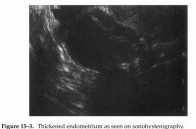
Tamoxifen is an antiestrogen, but it also acts as a partial estrogen agonist on the endometrium. Administration of unopposed estrogen can lead to endometrial proliferation and occasionally to carcinoma. Tamoxifen use has been associated with a variety of histopathologic changes in the endometrium, including increased endometrial thickness, increased uterine volume, proliferative changes, simple and complex atypical endometrial hyperplasia, endometrial polyps, and, rarely, endometrial carcinoma.
In the National Surgical Adjuvant Breast and Bowel Project P-1 trial, which included patients at increased risk for the development of breast cancer and which examined the value of tamoxifen in preventing second breast cancers, patients were randomly assigned to receive either tamoxifen 20 mg daily or placebo. The cumulative rate of endometrial cancer was 13.0 cases per 1,000 women in the tamoxifen group and 5.4 cases per 1,000 women in the placebo control group.
The increased risk in tamoxifen-treated women appeared at 1 year of tamoxifen treatment and increased progressively with treatment durations beyond 5 years. The relative risk of developing endometrial cancer after tamoxifen treatment increases with higher cumulative doses of tamoxifen and longer duration of exposure.
Recently, results of the Study of Tamoxifen and Raloxifene showed that another selective estrogen receptor modulator, raloxifene, is as effective as tamoxifen in reducing the incidence of breast cancer in postmenopausal women who are at increased risk for the disease and is associated with a lower risk of endometrial cancer (Land et al., 2006). Women who were randomly assigned to take raloxifene had 36% fewer uterine cancers than the women assigned to take tamoxifen. It is postulated that raloxifene may become more widely used than tamoxifen for breast cancer prevention in the near future.
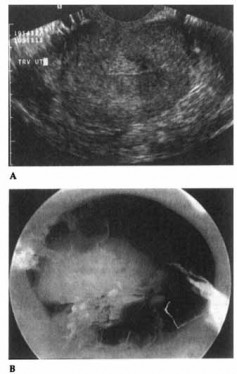
Figure 15-2. Endometrial polyp as seen on vaginal sonography (A) and hysteroscopy (B).
In women treated for breast cancer, the benefits of tamoxifen in terms of reducing the risk of breast cancer recurrence far outweigh the small risk of endometrial cancer. However, because of the risk of endometrial cancer, women taking tamoxifen must have frequent and thorough examinations.
Table 15-4 shows the American College of Obstetrics and Gynecology guidelines for care of patients undergoing treatment with tamoxifen (ACOG, 2006).
Sonography has proven to be useful for evaluating the endometrium in patients taking tamoxifen who have abnormal vaginal bleeding. Typical sonographic appearances of the endometrium in patients taking tamoxifen include thick, homogeneous hyperechogenic tissue with small cystic spaces; heterogeneous tissue with small cystic spaces; and solid heterogeneous tissue and polyps.
Written and revised by
Andrey Nailor, M.D.
Our doctors write and review articles for accuracy and keep them up to date.
health.am provides general information, not medical advice. Always consult a qualified health professional about your own health.
Explore health topics
More in this topic
Cancer → News
Long-term tamoxifen boosts breast cancer survival
Breast cancer patients who take the generic drug tamoxifen for five years are less likely to see their cancer return than those who take it for only two years, according to a large long-term study by British scientists.…
23 March 2011
 News
Taking tamoxifen to prevent breast cancer can save lives and money
Tamoxifen, taken by certain women as a preventive measure against breast cancer, saves lives and reduces medical costs. That is the conclusion of a new study published early online in CANCER, a peer-reviewed journal of…
14 March 2011
 News
Cough medicine could help doctors identify how breast cancer patients metabolize tamoxifen
Cough medicine could be used as way of predicting how well individual patients metabolise tamoxifen used in the treatment of their breast cancer, according to new research presented at the 22nd EORTC-NCI-AACR [1]…