Discovery of mechanisms predicting response to new treatments in colon cancer
Andrey Nailor, M.D.·Published 21 May 2012·8 min read
Key points
The Stem Cells and Cancer Research Group headed by Dr Héctor G.
Palmer´s team has described for the first time the molecular mechanisms through which the interaction between the oncogenic pathways of Wnt/beta-catenin and RAS/PI3K/AKT determines the response to treatments with pharmacological PI3K or AKT inhibitors.
Surgery (removing the cancer in an operation) is the most common treatment for all stages of colon cancer.
VHIO pioneers pre-clinical functional studies and clinical trials in the fight against cancer.
The Stem Cells and Cancer Research Group headed by Dr Héctor G. Palmer at the Vall d'Hebrón Institute of Oncology (VHIO) has identified the molecular mechanisms that determine patients' response to certain drugs used in clinical trials for colon cancer treatment. The study led by VHIO also benefited from the collaboration with Professor Alberto Muñoz´s laboratory at the Instituto de Investigaciones Biomedicas Alberto Sols, Consejo Superior de Investigaciones Científicas (IIB-CSIC-Madrid). Published today in Nature Medicine, this work identifies biomarkers that predict response to treatment and proposes therapeutic solutions for patients who do not respond well. These advances will guide better selection of treatments and avoid the risk of administering ineffective drugs.
Colon cancer is a disease caused by a malignant tumour in the large intestine. When detected early the tumor is removed through surgery and patients are treated with adjuvant chemotherapy, eliminating the disease in the majority of cases. However, in advanced stages, colon tumours are resistant to a broad spectrum of anti-tumour drugs and cancerous cells escape treatment and disseminate around the body, giving rise to metastasis. Currently there are no effective treatments to halt the progression of colon cancer in these later stages and most patients die as a result of disease progression.
Over recent years new drugs have been designed to target and block the activity of certain molecules responsible for promoting tumor growth and metastasis. Some of these, which are currently in clinical trials, are showing promising results in certain patients, while others show no improvement at all. This study headed by the VHIO examines the differential response to treatment and was supported by the Olga Torres Foundation (FOT), the Scientific Foundation of the Spanish Association Against Cancer (AECC), and the Carlos III Institute of Health (ISCIII).
New clinical horizons
Dr Héctor G. Palmer´s team has described for the first time the molecular mechanisms through which the interaction between the oncogenic pathways of Wnt/beta-catenin and RAS/PI3K/AKT determines the response to treatments with pharmacological PI3K or AKT inhibitors. Although both pathways are genetically altered in colon cancer, it is the over-accumulation of beta-catenin in the nucleus of cancer cells that makes them resistant to cell death induced by these anti-tumoral drugs.
Activation of the PI3K/AKT pathway retains the FOXO3a protein outside the cell nucleus, inhibiting its ability to act as a tumour suppressor that induces cell death. Therefore, "Targeting PI3K or AKT activity with these novel inhibitors allows relocation of FOXO3a in the nucleus promoting cell death. These drugs are being tested in clinical trials worldwide providing promising initial results in certain tumour types", explains Héctor G. Palmer, Head of VHIO´s Stem Cells and Cancer Group.
Written and revised by
Andrey Nailor, M.D.
Our doctors write and review articles for accuracy and keep them up to date.
health.am provides general information, not medical advice. Always consult a qualified health professional about your own health.
There are different types of treatment for patients with colon cancer.
Different types of treatment are available for patients with colon cancer. Some treatments are standard (the currently used treatment), and some are being tested in clinical trials. A treatment clinical trial is a research study meant to help improve current treatments or obtain information on new treatments for patients with cancer. When clinical trials show that a new treatment is better than the standard treatment, the new treatment may become the standard treatment. Patients may want to think about taking part in a clinical trial. Some clinical trials are open only to patients who have not started treatment.
Four types of standard treatment are used: Surgery, Chemotherapy, Radiation therapy and Targeted therapy
Surgery
Surgery (removing the cancer in an operation) is the most common treatment for all stages of colon cancer. A doctor may remove the cancer using one of the following types of surgery:
Local excision: If the cancer is found at a very early stage, the doctor may remove it without cutting through the abdominal wall. Instead, the doctor may put a tube through the rectum into the colon and cut the cancer out. This is called a local excision. If the cancer is found in a polyp (a small bulging piece of tissue), the operation is called a polypectomy.
Resection: If the cancer is larger, the doctor will perform a partial colectomy (removing the cancer and a small amount of healthy tissue around it). The doctor may then perform an anastomosis (sewing the healthy parts of the colon together). The doctor will also usually remove lymph nodes near the colon and examine them under a microscope to see whether they contain cancer.
Resection and colostomy: If the doctor is not able to sew the 2 ends of the colon back together, a stoma (an opening) is made on the outside of the body for waste to pass through. This procedure is called a colostomy. A bag is placed around the stoma to collect the waste. Sometimes the colostomy is needed only until the lower colon has healed, and then it can be reversed. If the doctor needs to remove the entire lower colon, however, the colostomy may be permanent.
Radiofrequency ablation: The use of a special probe with tiny electrodes that kill cancer cells. Sometimes the probe is inserted directly through the skin and only local anesthesia is needed. In other cases, the probe is inserted through an incision in the abdomen. This is done in the hospital with general anesthesia.
Cryosurgery: A treatment that uses an instrument to freeze and destroy abnormal tissue, such as carcinoma in situ. This type of treatment is also called cryotherapy.
Even if the doctor removes all the cancer that can be seen at the time of the operation, some patients may be given chemotherapy or radiation therapy after surgery to kill any cancer cells that are left. Treatment given after the surgery, to lower the risk that the cancer will come back, is called adjuvant therapy.
However, many colon cancer patients do not show any benefit. The reason for this is explained by Dr Palmer: "If the patients treated with these inhibitors show very high levels of nuclear beta-catenin, FOXO3a cannot induce cell death but promotes the opposite effect by escaping treatment and causing metastasis." According to Héctor Palmer, this finding has tremendous clinical value, since "the identification of nuclear beta-catenin as a biomarker to predict response guides the selection of patients who will benefit from treatment with PI3K or AKT inhibitors and discard their use in candidates who would provoke an adverse response."
Furthermore, Dr Héctor Palmer and his collaborators have discovered a solution for those patients for whom treatment with PI3K or AKT inhibitors would be contraindicated. They used an experimental drug that reduces the levels of nuclear beta-catenin, allowing the cell death induced PI3K or AKT inhibitors. These findings propose the combination of both types of inhibitors in the future for a more effective target-directed therapy in colon cancer.
{pagebreak}
Delivering on the promise of personalized medicine
VHIO pioneers pre-clinical functional studies and clinical trials in the fight against cancer. Importantly, Dr. Palmer´s team has developed in vivo models that accurately recapitulate disease progression in colon cancer patients. They inoculate the animals with cells derived from the patient's tumour, creating a "xenopatient" model. These cells regenerate the the disease in the animals with the same distinctive characteristics as in the individual patient, retaining its original genetic, clinical and pathological alterations. The xenopatients represent a parallel reality of each patient in the laboratory. This approach allows the study of disease progression and response to experimental medicines before subjecting the patient to new treatments. This model could soon form the basis of future functional, predictive and personalized cancer treatments.
Stage I (Dukes A) Colorectal Cancer
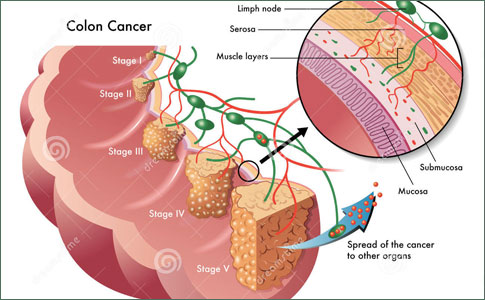
Stage I tumors have spread beyond the inner lining of the colon to the second and third layers and involves the inside wall of the colon. The cancer has not spread to the outer wall of the colon or outside the colon.
Standard treatment involves surgery to remove the cancer and a small amount of tissue around the tumor. Additional treatments are not usually needed.
Aggressive surgery to remove all of the cancer offers a great potential for cure. The five-year survival rate for stage I colorectal cancer is 93% according to the American Cancer Society.
Stage II (Dukes B) Colorectal Cancer
Stage II colorectal cancers are larger and extend through the muscular wall of the colon, but there is no cancer in the lymph nodes (small structures that are found throughout the body that produce and store cells that fight infection).
Standard treatment is surgical removal of the cancer and an area surrounding the cancer: A person with Dukes B colorectal cancer may also be a candidate for a clinical trial looking at the use of adjuvant immunotherapy or chemotherapy. Chemotherapy may also be given as a precaution against cancer recurrence.
The five-year survival rate for Dukes B colon cancer is 78%.
Stage III (Dukes C) Colorectal Cancer
Stage III colorectal cancers have spread outside the colon to one or more lymph nodes (small structures that are found throughout the body that produce and store cells that fight infection). Tumors within the colon wall which also involve the lymph nodes are classified as Dukes Stage C1, while tumors that have grown through the colon wall and have spread to one to four lymph nodes, are called Dukes Stage C2 cancers. Those tumors which have spread to more than four lymph nodes are classified as Dukes stage C3 colon cancers.
Treatment involves:
- Surgery to remove the tumor and all involved lymph nodes if possible. -After surgery, the patient will receive chemotherapy with 5-FU and leucovorin. - Radiation may be needed if the tumor is large and invading the tissue surrounding the colon
The five-year survival rate for Dukes C colon cancer is about 64%. Patients with one to four positive lymph nodes have a higher survival rate than people with more than five positive lymph nodes.
### For further information: Amanda Wren Communication Manager Vall d'Hebron Institute of Oncology (VHIO) Tel. +34 695 207886 e-mail: [email protected]
###
Amanda Wren [email protected] 34-695-207-886 Vall d´Hebron Institute of Oncology

 News
 News
 News