HRT After Diagnosis and Treatment of Breast Cancer
Key points
- The principle that women who have been treated for breast cancer should avoid exogenous estrogen has been an area of general agreement and standard practice for many years; it is based on both theoretical considerations and experimental data.
- A consensus statement regarding treatment of estrogen deficiency symptoms in women survivors of breast cancer was released after a conference of scientists and survivors (Sellers et al., 1997).
- In any discussion with a breast cancer survivor considering HRT, the health professional must carefully examine the woman's views and opinions regarding HRT, because the woman needs to be a thoughtful partner in all health-care decisions.
- Opinions about HRT shift in response to new studies, personal experiences, and anecdotes, and well-intended but frequently contradictory advice is quite common.
The principle that women who have been treated for breast cancer should avoid exogenous estrogen has been an area of general agreement and standard practice for many years; it is based on both theoretical considerations and experimental data. However, this proscription has been challenged recently because both the population characteristics and the health needs of women with a prior diagnosis of breast cancer have been changing. The emerging skepticism about our current practice regarding HRT in breast cancer survivors is reflected in many recent editorials and commentaries. Many investigators have emphasized the need for clinical trials specifically designed to evaluate the use of HRT in breast cancer survivors.
A consensus statement regarding treatment of estrogen deficiency symptoms in women survivors of breast cancer was released after a conference of scientists and survivors (Sellers et al., 1997). The consensus statement discourages use of HRT and encourages appropriate studies to explore alternatives.
In any discussion with a breast cancer survivor considering HRT, the health professional must carefully examine the woman's views and opinions regarding HRT, because the woman needs to be a thoughtful partner in all health-care decisions. Opinion pieces, editorials, scientific studies, and philosophical analyses of menopause and its "management" have occupied a prominent position in both the medical and popular literature in recent years. New titles are published regularly, adding information and points of view. In addition, women receive advice about HRT from their health-care providers, their relatives, and their friends.
Opinions about HRT shift in response to new studies, personal experiences, and anecdotes, and well-intended but frequently contradictory advice is quite common. The shifting opinions about HRT in the medical and lay literature underscore the complexity of decision-making regarding HRT after breast cancer. The long-standing "standard" position of regulatory agencies and medical practice that HRT is contraindicated in breast cancer survivors places significant constraints on health professionals.
In addition, many patients with a history of breast cancer are reluctant to receive HRT; this reluctance leads them to avoid estrogen despite considerable climacteric discomfort. It is important, however, to recognize that a number of women resolve that the potential benefits of HRT outweigh the potential risks and make a personal decision to begin taking estrogen (Vassilopoulou-Sellin and Zolinski, 1992; Utian and Schiff, 1994; Grodstein et al., 1997).
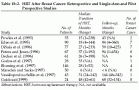
Many investigators have discussed the importance of developing appropriate guidelines for use of HRT in women with a history of breast cancer and have emphasized the need for clinical trials of HRT specifically designed for this population. We recently conducted a 5-year randomized clinical trial to assess the safety and efficacy of prolonged estrogen replacement therapy in a group of menopausal women with localized (stage I or II) breast carcinoma and a minimum disease-free interval of 2 years (if estrogen receptor status was negative) or 10 years (if estrogen receptor status was unknown) (Vassilopoulou-Sellin et al., 2002). In total, our analysis included 56 women receiving estrogen and 243 women not receiving estrogen; patient and disease characteristics were similar in the two groups. Two (3.6%) of the 56 women receiving estrogen developed a contralateral, new breast carcinoma, and 33 (13.5%) of the 243 women not receiving estrogen developed a new or recurrent breast carcinoma.
Written and revised by
David Cohen, M.D.
Our doctors write and review articles for accuracy and keep them up to date.
health.am provides general information, not medical advice. Always consult a qualified health professional about your own health.
Explore health topics
More in this topic
Cancer → News
ABC News' Amy Robach Reveals Breast Cancer Diagnosis
I remember exactly where I was when I got the call from a "Good Morning America" producer. I was about to interview Marie Monville, the wife of the Amish school shooter, in the bucolic setting of Lancaster, Pa. She was…
12 November 2013
 News
Mutations linked to breast cancer treatment resistance
Researchers at the University of Michigan Comprehensive Cancer Center have identified a type of mutation that develops after breast cancer patients take anti-estrogen therapies. The mutations explain one reason why…
5 November 2013
 News
New study shows positive personal growth following breast cancer diagnosis
Although being diagnosed with breast cancer is usually an extremely stressful experience for most women, a new study by researchers at Wake Forest Baptist Medical Center has found that there also can be unexpected…
26 October 2013