Chemotherapy in the Adjuvant Setting
Key points
- In a similar fashion to tamoxifen, the EBCTCG performed an overview of the worldwide randomized data for the use of adjuvant chemotherapy in early-stage breast cancer (almost 18,000 women randomized in 47 trials).
- Chemotherapy significantly reduced the annual risk of recurrence and mortality compared with no chemotherapy, and trials that used a combination of several agents (polychemotherapy) were superior to those of single-agent chemotherapy.
- Some have argued that the benefits of chemotherapy in younger patients (typically premenopausal women) are secondary to the actions of chemotherapy on ovarian ablation.
- With that said, there is little reason to believe that women over age 70 do not benefit from chemotherapy; however, the proportional benefits in this age group are not known.
In a similar fashion to tamoxifen, the EBCTCG performed an overview of the worldwide randomized data for the use of adjuvant chemotherapy in early-stage breast cancer (almost 18,000 women randomized in 47 trials). The chemotherapy regimen used in the majority of trials was CMF (cyclophosphamide, methotrexate and 5-fluorouracil [5-FU]).
Chemotherapy significantly reduced the annual risk of recurrence and mortality compared with no chemotherapy, and trials that used a combination of several agents (polychemotherapy) were superior to those of single-agent chemotherapy. The use of prolonged chemotherapy (regimens of typically 1-2 years) did not improve upon the efficacy of shorter regimens (3-6 months).
The benefits of chemotherapy were greatest in women younger than age 50; however, the reductions in the risk of recurrence and death were still significant for women in all age groups (Table 8.2 and Fig. 8.2).
Some have argued that the benefits of chemotherapy in younger patients (typically premenopausal women) are secondary to the actions of chemotherapy on ovarian ablation. Chemotherapy, however, appears to have the greatest impact in the youngest group of patients (age < 40), who are least likely to experience drug-induced amenorrhea. Unfortunately, few women greater than age 70 were randomized in these trials, and therefore insufficient dataexist to comment on the benefits of chemotherapy in this age group.
With that said, there is little reason to believe that women over age 70 do not benefit from chemotherapy; however, the proportional benefits in this age group are not known. Age alone should not be the only determinant for the use of adjuvant chemotherapy in women who are at substantial risk of recurrence.
Chemotherapy has a proportional reduction in the risk of recurrence and death among women with lymph-node positive and node-negative disease similar to that seen with tamoxifen. The absolute benefits of chemotherapy are dependent upon the underlying risk of recurrence, and therefore women with lymph-node positive disease derive the greatest benefit.
Table 8.2. Benefits of adjuvant chemotherapy
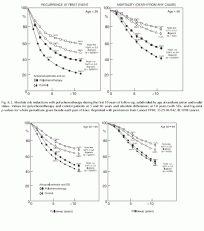
Fig. 8.2. Absolute risk reductions with polychemotherapy during the first 10 years of follow-up, subdivided by age at randomization and nodal status. Values for polychemotherapy and control patients at 5 and 10 years and absolute differences at 10 years (with SDs, and log-rank p-values for whole period) are given beside each pair of lines. Reprinted with permission from Lancet 1998; 352:930-942
This concept is best illustrated in , in which the proportional reductions in mortality are applied to three groups of patients at different risks of recurrence (node-positive, node-negative, and "good prognosis" node-negative with small tumors found on screening mammography).
Written and revised by
Gerald Hurowitz, M.D.
Our doctors write and review articles for accuracy and keep them up to date.
health.am provides general information, not medical advice. Always consult a qualified health professional about your own health.
Explore health topics
More in this topic
Cancer → News
Surgery beats chemotherapy for tongue cancer, U-M study finds
Patients with tongue cancer who started their treatment with a course of chemotherapy fared significantly worse than patients who received surgery first, according to a new study from researchers at the University of…
27 December 2013
 News
Targeted treatment plus chemotherapy could benefit women with ovarian cancer
Conventional chemotherapy could further extend life in some women with ovarian cancer when used in tandem with a new type of targeted treatment, a new international study shows. The research, published in the October…
13 October 2013
 News
New drug protects against side effects of chemotherapy
A drug developed at Linköping University in Sweden protects against the side effects of cancer treatments while strengthening the effects on the tumour. An international drug evaluation is now starting up on a larger…