Breath test spots toxic bug
Key points
- A simple breath test should be enough to detect infection from a bacterium that is thought to cause severe indigestion, stomach ulcers and cancer, say doctors.
- Professor Kenneth McColl, of Western Infirmary, Glasgow, told BBC News Online that his research suggested that people under the age of 55 who showed no symptoms of stomach cancer did not require endoscopy.
- H pylori causes problems because it injects a toxin into cells in the stomach lining.
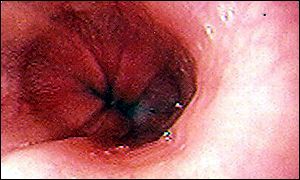
- At present, doctors often use an endoscope to look for the presence of Helicobacter pylori in the digestive tract.
A simple breath test should be enough to detect infection from a bacterium that is thought to cause severe indigestion, stomach ulcers and cancer, say doctors.
At present, doctors often use an endoscope to look for the presence of Helicobacter pylori in the digestive tract.
This involves feeding a tube with a camera on the end down the patient's throat and into the stomach. It can be uncomfortable and distressing.
A study published in the British Medical Association has found that a breath test is every bit as effective at diagnosing H. pylori infection.
Researchers examined 708 patients with indigestion who had been referred to hospital for endoscopic investigation to ascertain whether they were infected with H pylori, and had either a stomach ulcer, or signs of stomach cancer.
A total of 356 patients received a non-invasive breath test for H pylori and 352 received endoscopy plus H pylori testing.
After 12 months, the breath test was found to be as effective and safe as endoscopy.
Not only did patients prefer it, it was also cheaper.
Radioactive test
Professor Kenneth McColl, of Western Infirmary, Glasgow, told BBC News Online that his research suggested that people under the age of 55 who showed no symptoms of stomach cancer did not require endoscopy.
He said that people who were found to have H. pylori infection were given medication to treat stomach ulcers as standard practice, whether they had an ulcer or not.
The breath test works by giving patients a drink of radioactive urea.
In the presence of H. pylori this is broken down to radioactive carbon dioxide, which can be detected in the breath.
Professor McColl said: "It was thought that patients required endoscopy to reassure them, but our study found that this was not the case.
"Most expressed a preference for the less invasive breath test."
"It was thought that patients required endoscopy to reassure them, but our study found that this was not the case"
Professor Kenneth McColl
Toxin
H pylori causes problems because it injects a toxin into cells in the stomach lining.
This causes internal structures in the cells to swell up, and spill chemicals called enzymes out.
These help break down stomach mucus, and makes the whole layer of lining cells "leaky", allowing bacteria to obtain nutrients.
H pylori is blamed for an estimated 19 out of 20 duodenal ulcers, and the majority of gastric ulcers.
Written and revised by
Gerald Hurowitz, M.D.
Our doctors write and review articles for accuracy and keep them up to date.
health.am provides general information, not medical advice. Always consult a qualified health professional about your own health.
Explore health topics
More in this topic
Cancer → News
New at-risk group identified for gastrointestinal stromal tumors
Researchers at the University of California, San Diego School of Medicine have, for the first time, clearly defined the epidemiology of gastrointestinal stromal tumors (GIST), which occur primarily in the lining of the…
9 October 2014
 News
Testosterone promotes prostate cancer in rats
A researcher who found that testosterone raised the risk of prostate tumors and exacerbated the effects of carcinogenic chemical exposure in rats is urging caution in prescribing testosterone therapy to men who have not…
8 October 2014
 News
Accurate test for aggressive prostate cancer steps closer with genetic study
Researchers behind a new genetic study led by the University of Pittsburgh School of Medicine, PA, suggest their findings will lead to a more accurate test for aggressive prostate cancer and new ways to treat it.…