
Assessment of Risk and Choice of Adjuvant Therapy
Key points
- In order to decide which patients will benefit from the addition of adjuvant therapy, it is important to assess each woman's risk of developing recurrent disease.
- With this information, the absolute benefits of therapy can be estimated for each patient.
- By far the most important predictor for estimating the risk of recurrence is the number of ipsilateral axillary lymph nodes involved with metastatic carcinoma.
- For patients with negative lymph nodes, the risk of recurrence is lower, and the benefits of therapy must be weighed carefully against the side effects of treatment.
In order to decide which patients will benefit from the addition of adjuvant therapy, it is important to assess each woman's risk of developing recurrent disease. Competing comorbid conditions must also be considered. The overview analysis then provide an estimate of the reductions in the risk of relapse that can be expected from the administration of the drug therapies.
With this information, the absolute benefits of therapy can be estimated for each patient. These benefits must be balanced by consideration of the toxicities of the treatment, as well as of the expense and relative inconvenience of the drug administration.
By far the most important predictor for estimating the risk of recurrence is the number of ipsilateral axillary lymph nodes involved with metastatic carcinoma. A patient with even one positive lymph node has a risk of relapse of approximately 30%. An adjuvant therapy that reduces the odds of recurrence by at least 30% at 10 years would improve a woman's chances of disease-free survival by approximately 9%. Therefore, adjuvant therapy should be strongly considered for these patients.
For patients with negative lymph nodes, the risk of recurrence is lower, and the benefits of therapy must be weighed carefully against the side effects of treatment. Approximately one-quarter of such patients will eventually relapse with recurrent metastatic disease. This supports the concept that local control with surgery and radiation does not prevent the early dissemination of distant metastatic disease. Although all patients are not destined to relapse, it is difficult to select definitively which patients will recur, thereby sparing other patients the unnecessary treatment.
The ability to predict the biological behavior of breast tumors has been an active area of investigation, and potential prognostic factors, including hormone receptor status, S-phase fraction, DNA ploidy and cathepsin D, may help to select a group of patients who would benefit from adjuvant therapy. These variables often correlate with already proven factors such as tumor size and histopathologic features such as degree of differentiation and lymphovascular invasion. For node-negative patients, tumors measuring less than or equal to 1 cm have an excellent prognosis with a risk of relapse of only 12% at 20 years. The risk of relapse and mortality, however, increases with greater tumor size and axillary lymph node involvement (Table 8.3).
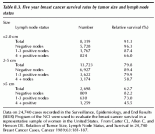
Table 8.3. Five year breast cancer survival rates by tumor size and lymph node status
Data on 24,740 cases recorded in the Surveillance, Epidemiology, and End Results (SEER) Program of the NCI were used to evaluate the breast cancer survival in a representative sample of women in the United States. From Carter CL, Allen C, and Henson DE. Relation of Tumor Size, Lymph Node Status, and Survival in 24,740 Breast Cancer Cases, Cancer 1989;63:181-187.
Written and revised by
Gerald Hurowitz, M.D.
Our doctors write and review articles for accuracy and keep them up to date.
health.am provides general information, not medical advice. Always consult a qualified health professional about your own health.
Explore health topics
More in this topic
Cancer → News
Preoperative/neoadjuvant therapy in pancreatic cancer
In research published this week in PLoS Medicine, Jörg Kleeff from Technische Universität München, and colleagues suggest that patients with apparently locally non-resectable tumors should be included in neoadjuvant…
22 April 2010
 News
Radiotherapy delay ups risk of breast cancer return
The longer women wait for radiotherapy after breast cancer surgery, the greater the risk their disease will come back, scientists said on Wednesday, in a study likely to pressure health services to cut waiting times.…
4 March 2010
 News
Hormone Therapy for Prostate Cancer Patients With Heart Conditions Linked to Increased Death Risk
Men with coronary artery disease-induced congestive heart failure or heart attack who receive hormone therapy before or along with radiation therapy for treatment of prostate cancer have an associated increased risk of…


