
Cardiovascular Complications of Cocaine Use

Key points
- The deaths of several celebrities in recent years in association with the nontherapeutic use of cocaine have focused widespread attention on the problem of cocaine abuse.
- Cocaine (benzoylmethylecgonine) is an alkaloid extracted from the leaf of the Erythroxylon coca bush, which grows primarily in South America.
- Cocaine use rose to epidemic levels in the early and mid-1980s, after which it declined in prevalence.
- In 1999, an estimated 25 million Americans admitted that they had used cocaine at least once; 3.7 million had used it within the previous year; and 1.5 million were current users.
The deaths of several celebrities in recent years in association with the nontherapeutic use of cocaine have focused widespread attention on the problem of cocaine abuse. In 1999, an estimated 25 million Americans admitted that they had used cocaine at least once; 3.7 million had used it within the previous year; and 1.5 million were current users. During the same year, cocaine was mentioned in 30 percent of all drug-related visits to emergency departments. Cocaine is the most commonly used illicit drug among subjects seeking care in hospital emergency departments or drug-treatment centers. In addition, it is the most frequent cause of drug-related deaths reported by medical examiners.
Cocaine use rose to epidemic levels in the early and mid-1980s, after which it declined in prevalence. However, between 1994 and 1998, the number of new cocaine users per year increased 82 percent, from 514,000 to 934,000. Several factors account for this recent increase in cocaine use, including the ease of its administration, the increased availability and purity of the drug, reduced cost, and the misperception that the recreational use of cocaine is safe. In a recent survey conducted by the Department of Health and Human Services, only 50 percent of young people expressed the belief that monthly cocaine ingestion carries a great risk of harm. In fact, as cocaine abuse has become widespread, the number of cocaine-related cardiovascular events, including angina pectoris, myocardial infarction, cardiomyopathy, and sudden death from cardiac causes, has increased dramatically.
Pharmacology and Mechanisms of Action
Cocaine (benzoylmethylecgonine) is an alkaloid extracted from the leaf of the Erythroxylon coca bush, which grows primarily in South America. It is available in two forms: the hydrochloride salt and the "free base." Cocaine hydrochloride is prepared by dissolving the alkaloid in hydrochloric acid to form a water-soluble powder or granule that decomposes when heated. It can be taken orally, intravenously, or intranasally, the slang terms for which are "chewing," "mainlining," and "snorting," respectively. The free-base form is manufactured by processing the cocaine with ammonia or sodium bicarbonate (baking soda) to remove the hydrochloride. This form is heat-stable and melts at 98°C, which allows it to be smoked. It is known as "crack" because of the popping sound it makes when heated.
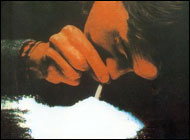
Since cocaine hydrochloride is well absorbed through all mucous membranes, abusers may achieve a high blood concentration by means of intranasal, sublingual, intravaginal, or rectal administration. As compared with the intravenous injection of cocaine, the mucosal administration of the drug results in a slower onset of action, a later peak effect, and a longer duration of action. Euphoria occurs within seconds after crack cocaine is smoked and is short-lived. Crack cocaine is considered to be the most potent and addictive form of the drug.
Written and revised by
Andrey Nailor, M.D.
Our doctors write and review articles for accuracy and keep them up to date.
health.am provides general information, not medical advice. Always consult a qualified health professional about your own health.
Explore health topics
More in this topic
Addiction → News
Cocaine-Related Myocardial Ischemia and Infarction
In 1982, Coleman et al. reported an association between cocaine use and myocardial ischemia and infarction. Subsequently, many reports have documented cocaine-related myocardial ischemic events. The risk of acute…
7 March 2008
NewsPharmacotherapy for Cocaine Abuse and Dependence
Cocaine abuse and dependence may be initiated and perpetuated by a wide range of physiologic, behavioral, and sociocultural factors. Recent treatment-center evaluations of urban, economically disadvantaged cocaine…
7 March 2008
 News
Management of Cocaine Abuse and Dependence
During the 20th century, there have been recurrent episodes of cocaine abuse in the United States that have achieved epidemic proportions. Although the total number of people using the drug has decreased in the past…
5 February 2008