|
It could soon be possible to detect breast cancer at a much earlier stage thanks to new technology being developed by British scientists.
Experts at University College London have discovered a way of identifying tumours when they are just 4mm wide.
At present, doctors often struggle to spot tumours more than twice this size because of the limits of conventional X-rays.
Scientists believe their breakthrough could one day help to save the lives of thousands of women each year.
Scattered rays
Dr Robert Speller and colleagues at UCL found that tumour cells have a different effect on X-rays compared to healthy cells - they scatter the rays in a variety of directions.
The scientists have developed a device, called Diffraction Enhanced Breast Imaging (Debi), to measure this effect and so identify potentially cancerous cells.
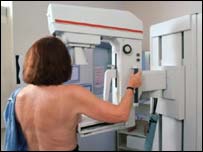
The device scans over the breast like a normal X-ray. But it also includes a second detector which can measure the scattering effect or diffraction.
If tumours are missed by the conventional X-ray, they can be picked up by this second detector.
The scientists have tested the device on breast tissue from patients undergoing breast reduction operations and from biopsies.
|
"We should be able to pick up something just 4mm in diameter " |
|
Dr Robert Speller, UCL |
According to New Scientist magazine, early results have been promising.
"We should be able to pick up something just 4mm in diameter, where conventional mammograms can only easily spot 10 to 12mm lumps," Dr Speller told New Scientist.
Clara MacKay, director of policy and research at the UK charity Breast Cancer Care, welcomed the breakthrough but said further research is needed.
"As a charity offering support and information to those affected by breast cancer, we would welcome any new technology which will improve outcomes both physical and psychological for women who have an increased risk of developing breast cancer.
"However, these kinds of advances in early detection also raise issues about appropriate management of such early lesions and clearly more research is needed."
Content provided by ArmMed Media
Revision date: 12 December 2007
Last revised by Amalia K. Gagarina, M.S., R.D.
««« »»»
|